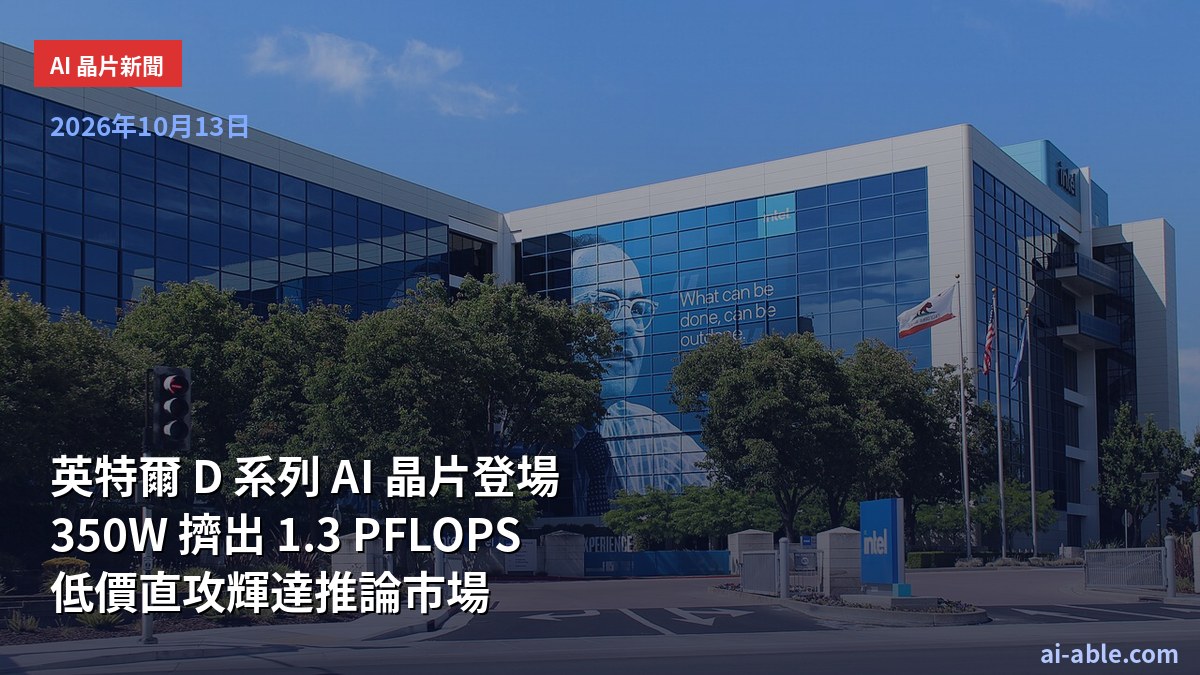
Intel Finally Shows Its Hand: Crescent Island Becomes the GPU D-Series
At the 2026 OCP Global Summit, Intel delivered its long-awaited answer: the AI inference chip codenamed Crescent Island is officially the Intel GPU D-Series, with full specifications for the flagship D270 revealed alongside the branding — and customer sampling already underway. This is Intel’s first commercial data center AI GPU since Ponte Vecchio in 2021. After canceling two successive designs — Rialto Bridge in 2023 and Falcon Shores in 2025 — Intel is taking a radically different route from Nvidia this time.
D270 Spec Breakdown: A 350W Bet on Performance-per-Dollar
The D270’s spec sheet is a strategy statement in itself: 256 XMX matrix engines running at roughly 2.5GHz deliver 1.3 PFLOPS of peak FP8 compute — at a total board power of just 350W in a standard PCIe CEM, air-cooled form factor. The memory subsystem is the headline feature: a 20-chip, 80-channel LPDDR5X bus provides up to 480GB of capacity at 1.5TB/s of bandwidth (Intel’s own card ships with 160GB; the 480GB variant comes from ODM partners).
On raw performance alone, those numbers are deliberately unremarkable. The D270 does not intend to go head-to-head with Nvidia’s Blackwell Ultra or AMD’s MI455X flagships. Intel’s calculation is simpler and sharper: use a much smaller chip, much cheaper LPDDR5X (instead of HBM), and a standard PCIe card to maximize inference throughput per dollar and per watt. As the industry’s pain point shifts from chip scarcity to capital expenditure and electricity bills, that positioning lands at exactly the right moment.

Xe3P: The Pragmatic Path of Matrix-Fortifying a Consumer Architecture
At the D270’s core sits Xe3P — an enhanced version of Intel’s Xe3 GPU architecture, fortified with far more XMX matrix engines and backed by an oversized LPDDR5X memory pool to keep them fed. This is not an AI monster built from scratch; it is a pragmatic, inference-specialized derivative of an existing architecture: 32 Xe cores, 32MB of L2 cache, ECC support, and a PCIe Gen5 x16 interface.
Industry analysis broadly agrees the 1.3 PFLOPS and 1.5TB/s figures land “right where expected — no surprises, no shortfalls.” Given current LPDDR5X speeds of around 9375MT/s and the clock levels similar accelerators are achieving, Intel is delivering precisely in the neighborhood it should. The real open question is whether 1.3 PFLOPS of FP8 proves sufficient for hyperscale data center inference workloads — something only deployment data will answer.
Why the Timing Matters: The Arms Race Is Shifting From Compute to Capital Efficiency
The D-Series arrives at a telling moment. In the same news cycle, the CEOs of Intel and Broadcom issued a rare joint warning: access to capital, not chip shortages, could become the biggest bottleneck for AI growth. Broadcom is arranging more than $50 billion in financing for custom AI chips with OpenAI, having already structured a $60 billion debt package for Anthropic’s build-out — with another $30 billion deal reportedly being sketched. The industry is literally borrowing its way into the AI era.
When “cost of capital” becomes the industry’s keyword, cheap, power-sipping, good-enough inference silicon turns from supporting act into headliner. Intel is aiming squarely at that gap: the ticket to training frontier models keeps getting more expensive, but what actually runs at massive scale every day is inference — chatbot responses, search summaries, agent tasks. Those workloads don’t want the strongest chip; they want the lowest unit cost. Every element of the D270’s design — 350W, LPDDR5X, PCIe CEM — optimizes that cost equation.
Nvidia’s Moat and Intel’s Opening
To be clear, the road ahead remains steep. Nvidia’s CUDA ecosystem, NVLink fabric, and mature software stack still form a moat that will not dry up soon, and AMD’s MI350P offers stronger peak compute in a comparable PCIe form factor. Intel’s lackluster commercial track record with the Gaudi line has left the market skeptical of its execution.
But the D-Series plays it smart by not contesting the most glamorous slice of the market. Inference customers are far less locked in than training customers, and open-source inference frameworks such as vLLM and SGLang are increasingly backend-agnostic. If the D270’s real-world price-performance delivers on what the spec sheet promises, Intel has a genuine shot at carving open a real gap in the 2027 inference market — precisely the highest-margin, least-defended corner of Nvidia’s empire.
Conclusion: A “Good Enough” Revolution Begins
Intel’s D-Series launch marks the second phase of the AI chip race. Phase one was about whose chip is strongest; phase two is about whose inference cost is lowest. When industry leaders warn that money — not chips — is the bottleneck, the D270’s plain numbers (350W, 1.3 PFLOPS, 480GB of LPDDR5X) may sit closer to AI’s real future than any flagship’s dazzling benchmarks. For investors and technology decision-makers, the three signals to watch next are: the D270’s first major customer names, measured inference throughput per watt, and whether Nvidia responds with cut-rate variants of its own.