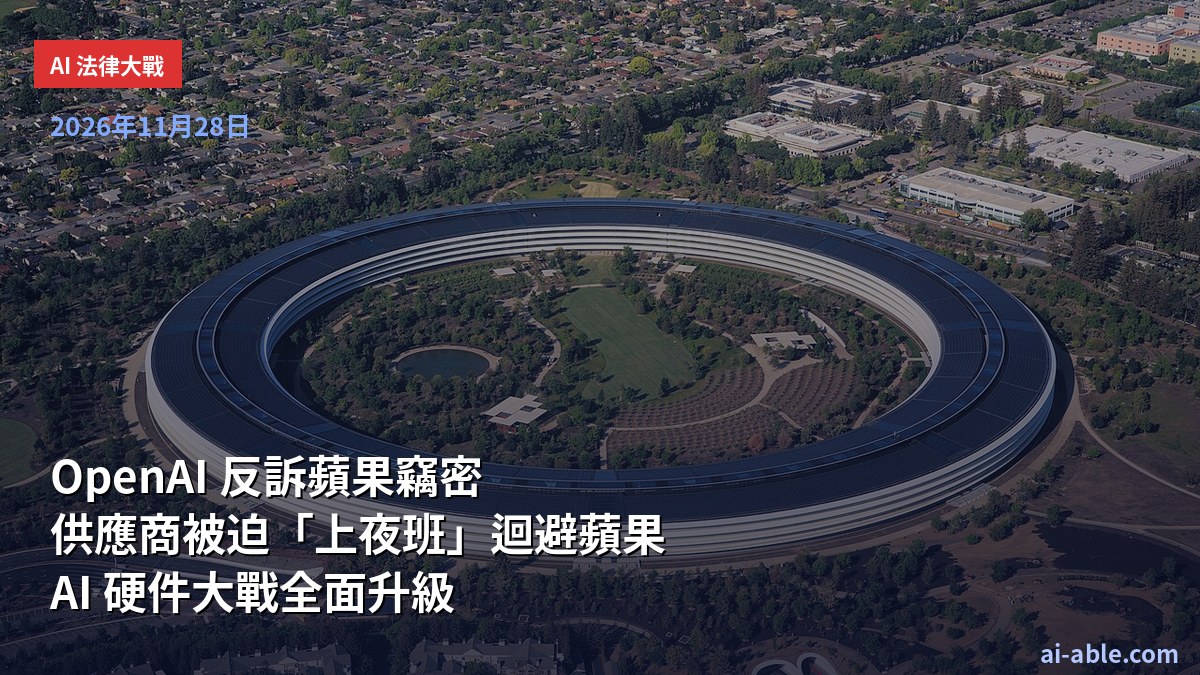
When the world’s hottest AI company decides to build its own hardware, how much resistance does it meet? OpenAI’s answer, filed in court: enough to force suppliers onto night shifts. On November 27, 2026, OpenAI filed counterclaims against Apple in federal court in San Jose, accusing the iPhone maker of stealing OpenAI’s trade secrets and threatening suppliers working on its future devices — transforming the lawsuit Apple launched in July into a full-blown two-way intellectual property war.
Three Lines of Attack: Stolen Secrets, Coerced Suppliers, Locked-Up Talent
First reported by the Financial Times and confirmed by Reuters and Bloomberg, OpenAI’s filing accuses Apple of trying to “compete unfairly by any means available.” The counterclaims run along three tracks. First, Apple stole OpenAI’s own secrets: an engineer who spent just six months at OpenAI before returning to Apple allegedly sent more than 100 confidential files — covering unreleased devices, engineering data and supplier information — to personal accounts on June 2, his last day. Second, Apple is “coercing and threatening” suppliers that work with OpenAI, pressuring them to disclose details of OpenAI projects and the names of workers with Apple experience, then excluding those workers from Apple business. Third, Apple uses overbroad employment restraints to keep engineers from jumping ship.
The filing states it plainly: “Apple’s power over suppliers and engineers cannot lawfully be used to exclude competing purchasers and employers from the market.”
The “Hotel California” Employment Trap
The sharpest accusation in the filing is OpenAI’s description of Apple’s internal practices as a “Hotel California” trap — you can check in any time you like, but you can never leave. OpenAI alleges Apple encourages employees to store corporate files on personal devices and cloud accounts, then uses that same material to accuse them of “stealing” trade secrets when they depart. In practice, every former Apple employee who joins OpenAI becomes a potential legal liability. According to the counterclaims, roughly 400 former Apple employees have now joined OpenAI.
Suppliers’ “Night Shift Survival”: Absurd but Real
The supplier ecosystem revealed in the filing is more dramatic than any TV script. One supplier providing specialist finishing services for OpenAI products allegedly moved OpenAI’s manufacturing work to the night shift — purely to avoid overlapping with Apple’s orders — under pressure from Apple, raising OpenAI’s costs. “Suppliers have expressed fear of losing Apple business and have moved or rescheduled meetings with OpenAI to avoid Apple seeing them,” the filing says. “Other suppliers have told OpenAI personnel that they must be cautious about devoting staff, production resources, or managerial attention to OpenAI.” With smartphone shipments down 21.2% and component costs climbing, whoever controls scarce manufacturing capacity holds the ticket to the next generation of AI devices.
Apple Fires Back: A “Transparent Distraction”
Apple responded swiftly: “This case is about OpenAI employees deliberately stealing, accessing, and using Apple’s secret and confidential information regarding our unreleased technologies, processes, and products — not about inadvertent retention of Apple information. OpenAI’s counterclaims are a transparent attempt to distract from the substance of Apple’s lawsuit, in which OpenAI has already been ordered to stop using Apple’s confidential information.”
For context: Apple’s original July lawsuit named OpenAI, its hardware company io Products, and two former Apple employees — Tang Tan, who once led iPhone and Apple Watch product design and is now OpenAI’s chief hardware officer, and engineer Chang Liu. Apple alleges OpenAI orchestrated a campaign to extract Apple hardware secrets through job candidates and hires, has sought a preliminary injunction, and won expanded access to evidence during discovery. The case is scheduled for trial on July 19, 2027.
Tellingly, OpenAI voluntarily agreed in October not to use Apple’s trade secrets and asked a judge to toss the lawsuit; on the 100-files allegation, Apple said at the time its investigation had not located OpenAI confidential information and asked for more specifics. Both sides stand firm — the truth is now for the court to decide.
Why This Case Decides the Future of AI Hardware
On the surface it is a trade-secrets dispute; underneath, it is the opening battle for AI hardware supremacy. Since acquiring Jony Ive’s io firm last year, OpenAI has been developing a family of consumer devices — reportedly starting with a doughnut-shaped smart speaker — putting it on a direct collision course with Apple’s core territory. The two companies once had a honeymoon: ChatGPT was deeply integrated into iPhone, iPad and Mac software, though the relationship has cooled in recent months. For OpenAI, dominance in software is not enough — to get AI off the phone screen, it must fight Apple for the same suppliers, the same engineers and the same production lines.
The industry lesson is equally sharp: when AI giants cross into hardware, incumbent consumer-electronics powers can raise a triple moat of litigation, supplier networks and employment clauses. This case’s verdict will set a defining precedent on whether a software company can break into the hardware market at all.
Conclusion
From Apple’s July opening salvo to OpenAI’s November counterstrike, there is no turning back. In the short term, expect discovery battles and injunction skirmishes to dominate headlines until the July 2027 trial. In the medium term, OpenAI’s hardware roadmap will labor under the lawsuit’s shadow, and every supplier’s choice between picking a side and hedging is rewriting the rules of the AI hardware supply chain. As for what consumers most want to know — when that doughnut-shaped speaker will actually ship — the answer will likely stay suspended until the court stamps its seal. Investors should also watch closely: supply-chain rotation in AI hardware may reflect this lawsuit’s momentum faster than any benchmark score.
Sources: Financial Times, Reuters, Los Angeles Times, 9to5Mac (November 27, 2026)