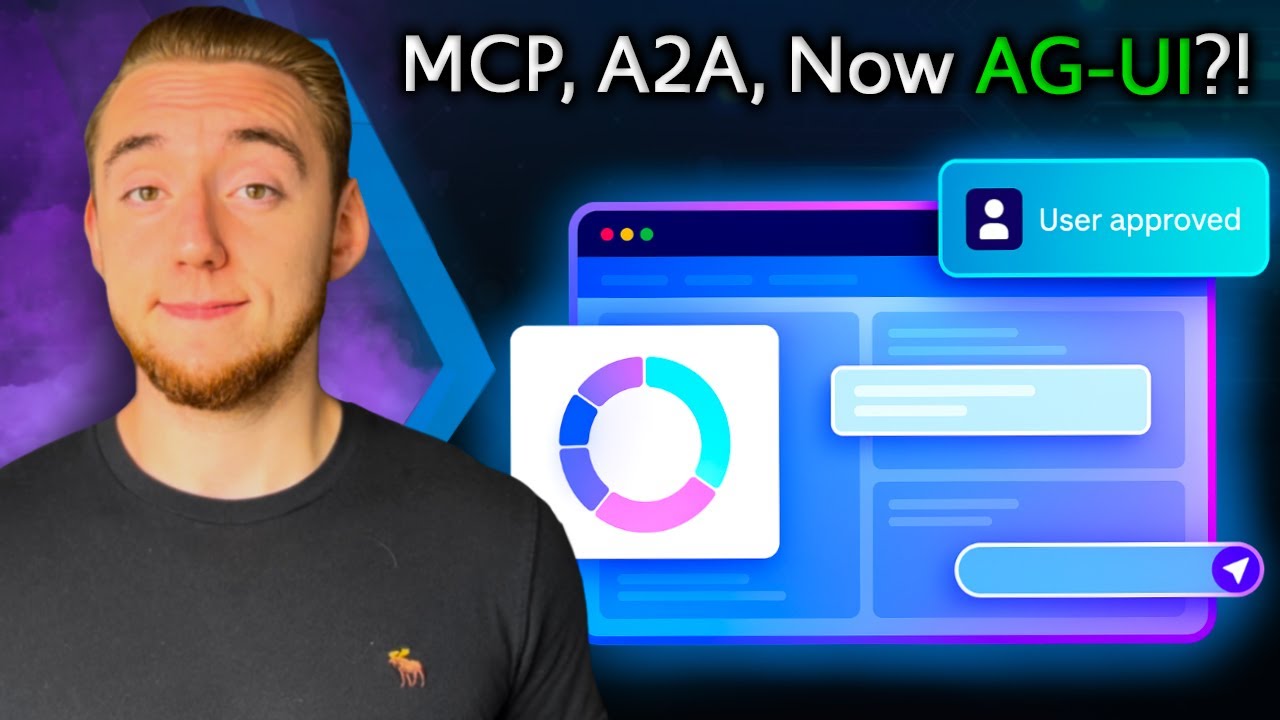
2025 marks a groundbreaking year for AI agents, introducing revolutionary protocols that empower seamless connectivity and interaction. Amongst these innovations, AG-UI stands out as the latest protocol that bridges the crucial gap between AI agents and user-facing frontends, enabling the development of highly interactive and feature-rich AI agent applications.
What is AG-UI?
AG-UI, developed by the CopilotKit team, serves as a standardized protocol to connect AI agents with front-end applications. Much like Anthropic’s Model Context Protocol (MCP) facilitates connecting tools to agents and Google’s A2A connects agents to other agents, AG-UI simplifies how we build interfaces that allow users to interact dynamically with AI agents.
Why AG-UI is a Gamechanger?
While AI agents are powerful on their own, user interaction is essential for practical and effective applications. Prior to AG-UI, integrating AI agents into user-friendly frontends required complex, custom development often constrained by different backend frameworks and streaming challenges.
AG-UI addresses this by providing a universal set of standard events that manage everything from real-time token streaming, tool orchestration, to error handling, making frontend development streamlined and compatible with any AI backend framework such as LangChain, Crew AI, or Pyantic AI.
How AG-UI Works
The architecture of AG-UI consists of a middleman protocol that connects a frontend (built with frameworks like React) to various AI agents. When an operation occurs, such as streaming text or executing tool calls, the agent emits standardized events through AG-UI to the frontend, which then renders these in real-time.
This event-driven protocol simplifies front-end handling of complex agent behaviors like streaming responses, tool progress visualization, and user interactions.
AG-UI in Action: Demo Highlights
The demo showcased AG-UI connecting a React-based frontend with AI agents capable of streaming responses in real-time, tool orchestration to control the frontend UI like background color changes, and interactive tool-based outputs such as generating a haiku about AI. This level of interaction was previously difficult to implement without such a standardized protocol.
Flexibility Across Frameworks and Languages
One of AG-UI’s major strengths is that it is framework-agnostic and not limited to any single programming language. The video illustrated how an AI backend built with JavaScript can be easily swapped out for a Python-based FastAPI backend without changing the frontend. This opens the door for developers to choose their preferred tools and environments while maintaining frontend consistency.
Recommended Tools & Resources
- AG-UI Documentation: Comprehensive official docs to get started with AG-UI (docs.ag-ui.com)
- GitHub Repository: AG-UI official demo app for practical experimentation (github.com/ag-ui-protocol/ag-ui)
- CopilotKit: An open-source frontend library to build agentic applications easily (copilotkit.ai)
- Lutra: An AI automation platform integrating MCP servers for enhanced workflows (lutra.ai)
Internal Resources to Deepen Your Knowledge
- Ultimate RAG + MCP Server for AI Coding – Explore how MCP connects tools with agents, complementing AG-UI’s role in frontend integration.
- AI-Powered YouTube to WordPress Auto Blog with N8N – Learn about automating content workflows that could integrate with AI agents.
- The Future of AI in Recruitment – Understand AI agent applications in real-world industries.
Conclusion
AG-UI opens new horizons for developers looking to create sophisticated agentic applications by standardizing how AI agents interface with user frontends. With its open-source nature and cross-framework compatibility, it promises to accelerate the evolution of AI-driven applications. We recommend developers and enthusiasts to explore AG-UI early and integrate it into their AI projects to stay ahead in this dynamic field.
For ongoing tutorials, demos, and advanced use cases on AG-UI and AI agents, keep an eye on Cole Medin’s channel and join communities like dynamis.ai for continuous learning.