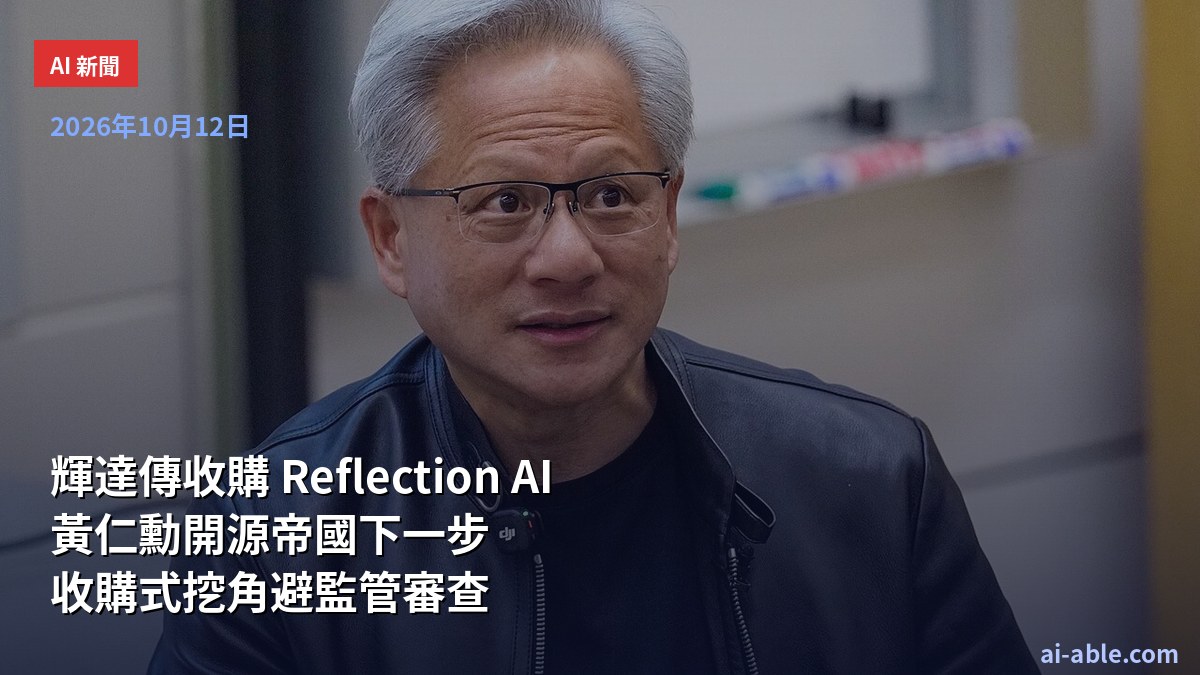
A bombshell from the Financial Times on Saturday evening: Nvidia is in talks to acquire or deepen its investment in Reflection AI, an open-weight AI model startup, with people familiar with the matter saying a deal could land “within weeks” — though the talks could still collapse. Behind the potential transaction is Jensen Huang’s next move in building an open-source AI empire, and the most intriguing detail is the possibility that Nvidia will use an “acquihire” structure specifically to sidestep antitrust review.
How the Deal Could Take Shape: Buy, Double Down, or Just Hire
The FT laid out three possible structures: a full outright acquisition; an increased equity stake, possibly alongside a bigger supply of chips and computing power; or an acquihire — Nvidia hires Reflection’s staff and licenses its technology without taking control of the company. The paper noted pointedly that the last structure “would likely avoid a lengthy regulatory review.”
This is not theoretical — Nvidia has demonstrated both playbooks in the past year. In December 2025, inference chip startup Groq licensed its technology to Nvidia in a deal reported at $20 billion, with founder and CEO Jonathan Ross moving to the chipmaker alongside senior executives while Groq kept running its cloud business independently. On September 3, Nvidia agreed to pay $12.9 billion for model-hosting platform Hugging Face in a straight purchase. Buying companies, renting talent, licensing tech — Huang’s toolbox has every instrument.
Who Is Reflection AI: A $25 Billion Unicorn Founded by DeepMind Alumni
Reflection AI was founded in 2024 by two former Google DeepMind researchers, Misha Laskin and Ioannis Antonoglou, with an initial focus on coding agents. The company is already firmly in Nvidia’s orbit: Nvidia led its $2 billion funding round in October 2025 and has invested roughly $800 million in total. Laskin confirmed to CNBC in April that the startup’s latest round closed at a $25 billion pre-money valuation. The cap table also includes Sequoia Capital, Lightspeed Venture Partners and DST Global.
Beam: Launched Five Days Ago, Aiming at China’s Open-Source Army
The timing is striking. Five days before the FT report landed, Reflection unveiled its first open-weight model, Beam — a 501-billion-parameter mixture-of-experts model focused on coding and agentic work, pitched directly against lower-cost Chinese open models such as DeepSeek and Kimi. Nvidia CEO Jensen Huang publicly called in July for a domestic open-weight “ecosystem” that he described as “essential for creating opportunities for innovation and prosperity.” Acquiring Reflection would hand him the centerpiece of that puzzle.
On the compute side, Beam was trained on Nvidia GB300 systems that Reflection rents from SpaceX under a June agreement worth up to $6.3 billion — payments of $150 million a month cover capacity at SpaceX’s Colossus 2 data center in Memphis through 2029, and Nebius agreed in July to sell Reflection another $1 billion in AI capacity. A startup burning compute at that scale tells you everything about the intensity of the AI infrastructure war.
The Acquihire Wrinkle: Clever or Dangerous?
The most debated aspect of the deal is the regulatory implications of the acquihire structure. Over the past year, regulators worldwide have grown increasingly wary of Big Tech “hiring away entire teams without buying the company” — such arrangements keep deal values, patents and control changes below the surface while achieving the substance of talent and technology consolidation, all without triggering merger-review obligations. If Nvidia takes Reflection’s research team this way, it would absorb a force capable of countering China’s open-source army via the path of least resistance.
Markets reacted immediately and brutally: Nvidia’s stock came under pressure after the news, partly because investors began pricing in the uncertainty of an “acquisition cycle” — Arm has tumbled more than 46% from its all-time high, and neocloud names like CoreWeave and Nebius fell in sympathy. Nvidia must sustain its own valuation while convincing the market that every acquisition widens the moat rather than depleting the ammo.
Open vs. Closed: Nvidia’s Calculus
On the surface, a chip company buying an open-weight model lab seems counterintuitive — open models can be downloaded by anyone, so where’s the revenue? But the logic is sharp: open-weight models still run their inference on Nvidia silicon, and often in a more distributed, higher-frequency pattern than closed models. As closed-model giants like OpenAI and Anthropic design their own chips and build their own data centers to reduce dependence on Nvidia, nurturing the open ecosystem guarantees a long-term demand line for its GPUs that no single big customer can abandon. What Nvidia is buying isn’t the model itself — it’s a future in which the open ecosystem keeps burning compute.
Conclusion: Weeks to Find Out
Whether the deal lands as a full acquisition, an increased stake or an acquihire, Nvidia’s pursuit of Reflection AI marks a new phase of the AI race: vertical integration between chip dominance and model ecosystems is turning from an optional question into a mandatory one. Huang’s open-ecosystem blueprint from July could gain its most important piece within weeks. For developers and investors, three signals to watch: which deal structure is ultimately chosen, whether regulators move against the acquihire playbook, and whether Beam’s open-source strategy changes once inside the Nvidia fold.