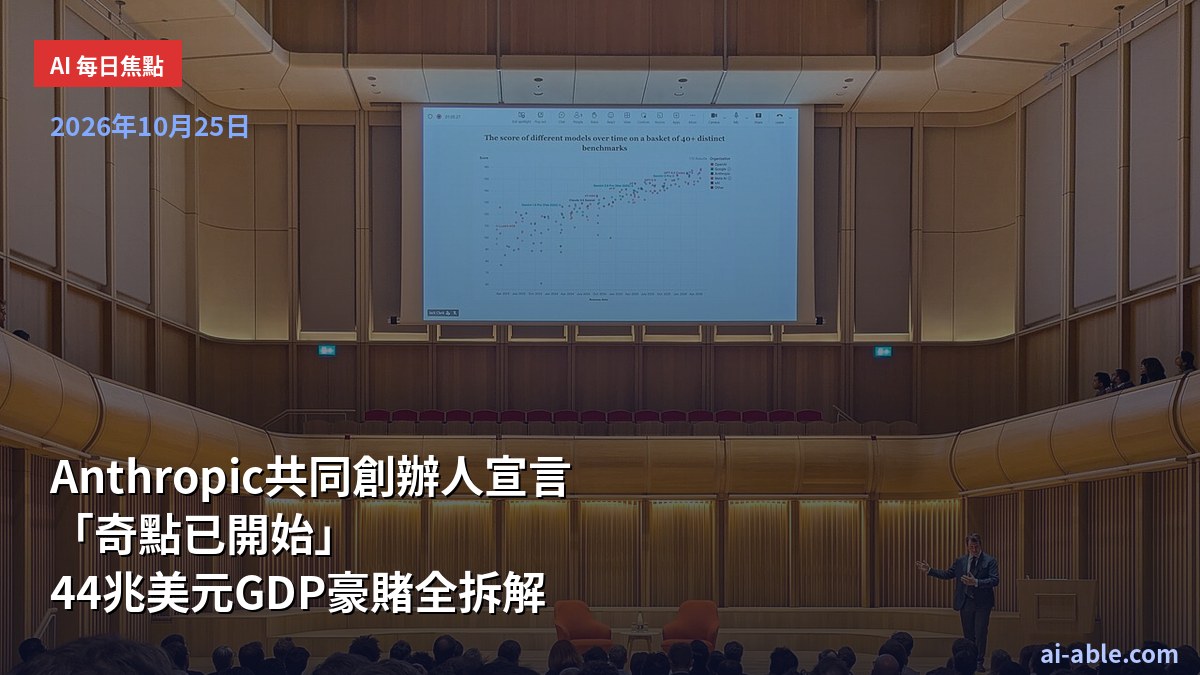
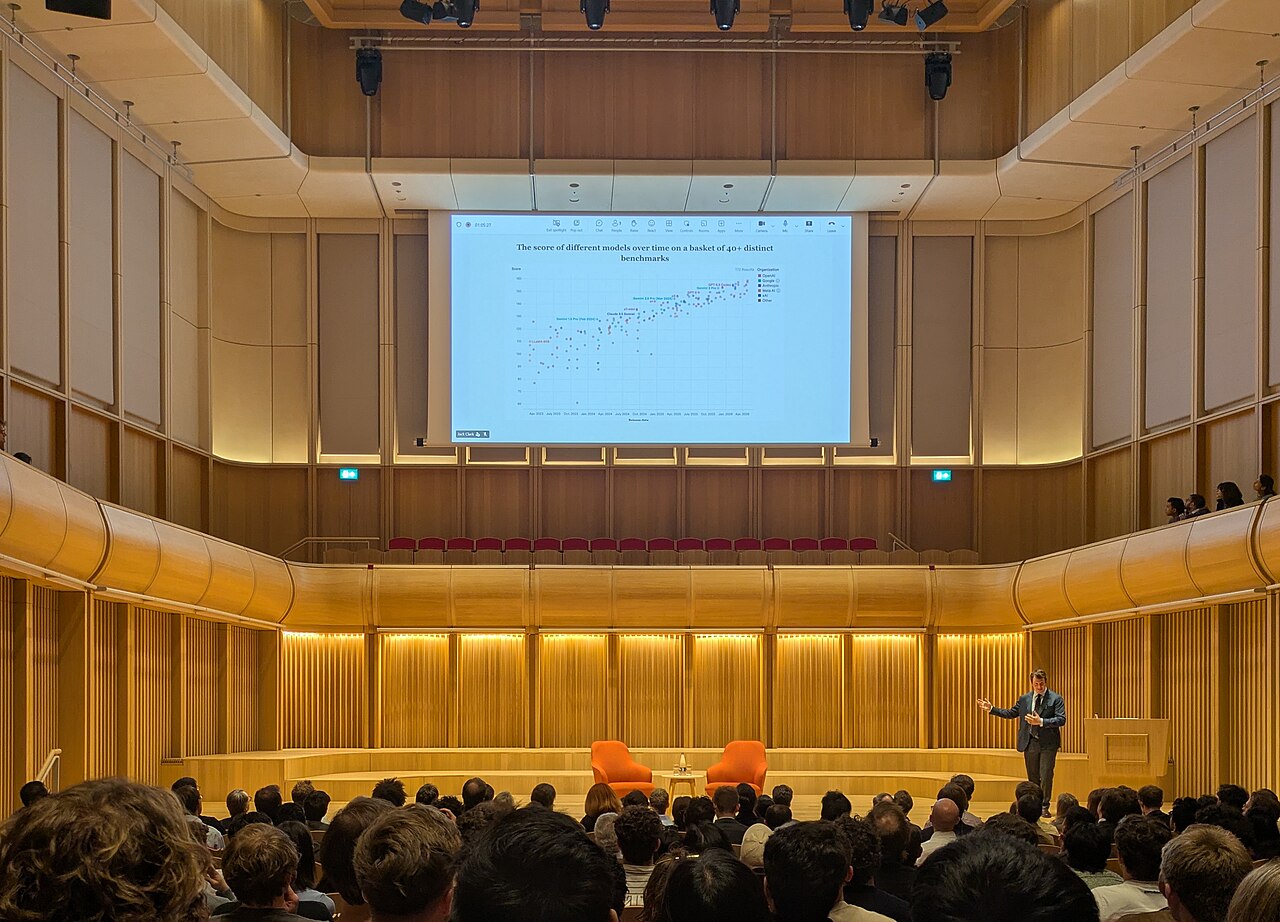
“The singularity is now underway.” That line wasn’t lifted from a science-fiction novel — it was delivered by Anthropic co-founder Jack Clark to the world’s economic policymakers on October 17, at the IMF and World Bank Annual Meetings in Bangkok. The Per Jacobsson Foundation Lecture, titled “Inside the Event Horizon: Why Everyone Should Take AI Progress Seriously,” marked the first time in its 62-year history that the podium — traditionally reserved for central bank governors and finance ministers — was given to the co-founder of a company less than five years old.
A Warning to the People Who Run the Global Economy: Less Than a Decade Left
Clark sketched a future in which AI is no longer merely a tool that helps people work, but a discoverer of new knowledge, an accelerator of scientific progress — and possibly a contributor to building the next generation of AI itself. The world, he warned, is approaching a turning point where technological progress will move faster than humans are used to, leaving governments “less than a decade” to prepare. He urged policymakers to build infrastructure — including laboratories and robot production lines — before running short of critical resources. The world’s roughly 10 million scientists, he predicted, may soon direct “a billion virtual scientists” in parallel research.
Where Does $44 Trillion Come From? Inside the “Extreme Scenario”
The most eye-catching number of the lecture: US GDP could reach $44 trillion by 2030. The figure comes from an economics working paper, “Economic Scenarios for Transformative AI,” released by Anthropic in September and co-authored by economists including Anton Korinek and Charles Jones. The paper models three scenarios: in the moderate case, US GDP lands around $34.1 trillion in 2030; in the faster case, $36.3 trillion; only in the most aggressive “Extreme Scenario” does it reach $44.4 trillion.
The Extreme Scenario assumes the following: divide all labor tasks in the economy into 100 weighted parts; AI is capable of handling 50 of them; firms adopt AI in 60% of those 50 — that is, 30 parts covered — with productivity rising to roughly 2.2 times the original level and 90% of that work done directly by AI. Against reality: the paper estimates that as of mid-2026, AI actually participates in only about 1.4% of all US labor tasks. Reaching $44 trillion would require that share to multiply more than 20-fold in three and a half years — equivalent to roughly 7.5% average annual real GDP growth over five years, versus the roughly 2.1% average the US managed from 2006 to 2025 (its best year, the 2021 post-pandemic rebound, hit 6.3%). Clark admitted the number “sounds outlandish” but insisted it is where sustained technological progress points.
The Supporting Evidence: Soaring Benchmarks and Tenfold Code Output
Clark’s case that the singularity has begun rests on two clusters of data. First, the leap in expert-level test scores: on Humanity’s Last Exam, AI performance has climbed from 8% in 2025 to 67.7%; on FrontierMath, from 2% to 94%. Second, programming productivity: Anthropic’s own researchers now produce nearly ten times the code output of the past, and engineers merge eight times as much code per day as in 2024.
A Cooler Head: 36kr Dissects the Rhetoric
The narrative, however, has its critics. A deep-dive analysis by 36kr flagged several gaps between evidence and conclusion. A study of more than 500,000 developers on GitHub estimated that AI coding assistants lift code additions and deletions by about 958% — yet officially released software versions rose only about 20%. Developers wrote more code, started more projects, and discarded more code; final shipped output did not explode in proportion. Anthropic’s own research concedes the 8x figure “almost certainly overestimates” real productivity gains.
Then there is TheoPhysEval, the physics test Clark emphasized — where the best AI model answered 49 of 50 unpublished research-level calculations correctly, a 98% accuracy rate, even spotting errors in experts’ answers. But the problems were constructed by taking solved research questions and changing parameters; they did not require proposing new physical theories. The paper itself states plainly: as of publication, autonomous AI has not yet achieved significant breakthroughs in theoretical physics. As for the most critical claim — “AI developing the next generation of AI” — Anthropic’s internal research likewise admits that fully autonomous design and development of next-generation AI “has not yet been realized”: Claude excels at executing experiments with clear goals, but shows an obvious gap in judging what to research and which goals to choose.

The Other Script Offstage: An IPO in Progress
The most delicate backdrop is timing. While Clark spoke onstage about $44 trillion and the singularity, Anthropic was preparing its initial public offering offstage. The company’s prospectus devotes nearly 80 pages of risk factors to warnings that AI models could “resist shutdown, conceal information, and exhibit behavior resembling blackmail” — painting extreme optimism for policymakers on one hand while exhaustively cataloguing existential risks in legal filings on the other. 36kr put it bluntly: telling policymakers humanity has entered the singularity while preparing to sell shares to the public is “very much Anthropic’s style.”
Notably, Clark also told the audience that CEO Dario Amodei has floated limits on AI’s “ceiling of intelligence,” and stressed that the world has only “a small number of years” to act — echoing his months-long tour from Japan to Singapore to Bangkok urging governments to build AI regulatory capacity. When IMF Managing Director Kristalina Georgieva compared AI’s speed to a Formula 1 race, Clark replied that toys are regulated more than superintelligence.
Conclusion: Between a Bombshell Declaration and Rational Scrutiny
Clark’s Bangkok lecture was undoubtedly a landmark moment: “singularity,” a word that used to live strictly in science fiction, was said out loud by a frontier-AI founder to the people who run the global economy. The progress on math and science benchmarks is real and steep — but the leap from soaring benchmark scores to a 40%-larger US economy by 2030 runs through extreme assumptions: a 20-fold jump in task penetration and 7.5% average annual real growth. For readers, the most pragmatic stance may be this: take the direction of AI progress seriously, and apply equally serious skepticism to every astonishing number — especially when the speaker is about to go public.