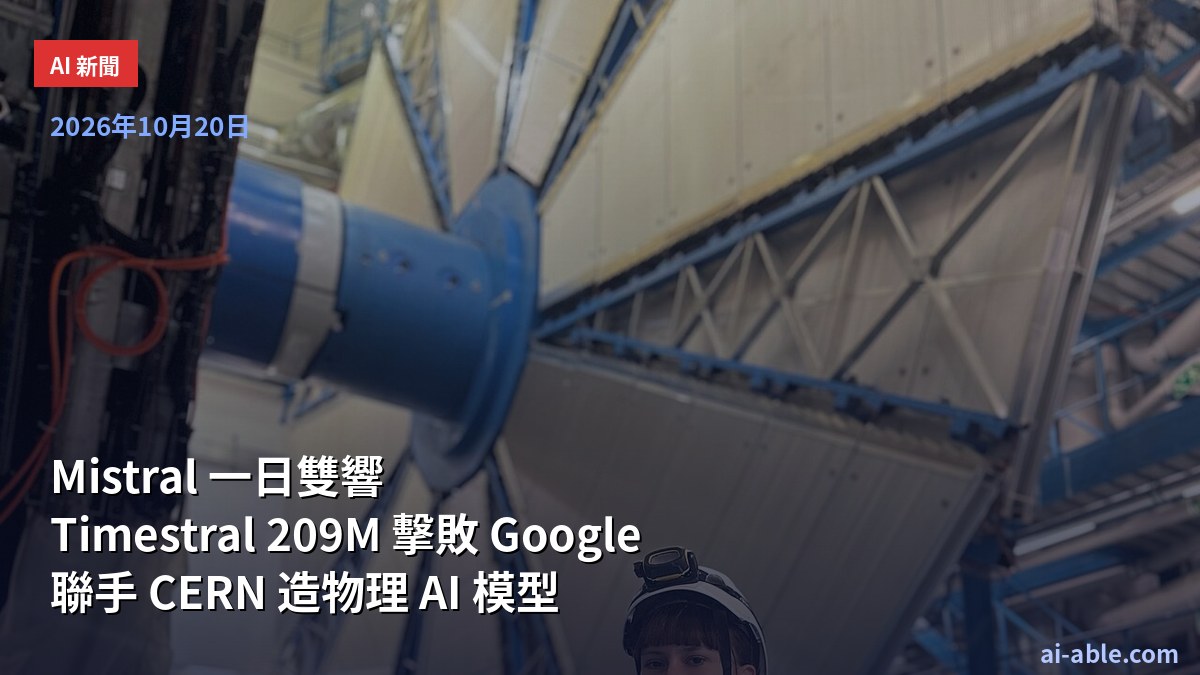
French AI lab Mistral delivered a two-front statement on October 15: it introduced Timestral, its first family of time-series foundation models — whose largest version, at just 209M parameters, sweeps all three major public benchmarks, beating Google’s TimesFM-3, and runs inference without a GPU — and on the same day signed a strategic partnership with CERN to build the first-ever foundation model for collider physics. From enterprise forecasting to particle physics, European AI is accelerating on two fronts at once.
What Is Timestral? A 209M-Parameter Pocket Rocket
Timestral is Mistral’s first Time-Series Foundation Model family, delivering probabilistic, multivariate forecasts with support for both past-only and known-future covariates. The flagship 209M model ranks first on all three of the field’s main public benchmarks — GIFT-Eval, TIME, and fev-bench — outperforming the previous state of the art with only about two-thirds of the parameters, with Google’s TimesFM-3 and Falcon-2.0 among the models it overtakes.
The family ships in four sizes — 5M, 28M, 123M and 209M parameters — sharing one architecture and training recipe, with every size sitting on the Pareto front of forecasting accuracy versus model size: no public model forecasts better at the same size. The 28M version already beats Chronos-2, roughly four times larger, on GIFT-Eval and TIME. Efficiency is the other headline: Timestral needs no GPU at inference and runs on standard server CPUs. Technically, the models combine synthetic pre-training, covariate-aware attention and long-context learning, with fine-tuning available via Mistral Forge for domain adaptation.
The contrast with classical methods is stark. ARIMA and linear regression fit a single series and learn only from its own history; deep models like PatchTST can learn nonlinear patterns across related series but are still trained from scratch on each dataset. Time-series foundation models bring the pre-training paradigm to forecasting: trained on a large, diverse corpus, they forecast zero-shot on data they have never seen — even in domains where data is scarce.
CERN Joins Mistral: The First Collider-Physics Foundation Model
The same day, CERN and Mistral signed a statement of intent to establish a long-term strategic partnership. At its heart is the ambition to develop a single pretrained Large Physics Model — the first foundation model for collider physics — trained on billions of simulated proton-proton collisions from the Large Hadron Collider (LHC). It is designed to support multiple tasks, from reconstructing particle collisions and identifying particles to flagging unexpected signals and evaluating future detector designs. Some outlets report the model carries the codename “Flare”.
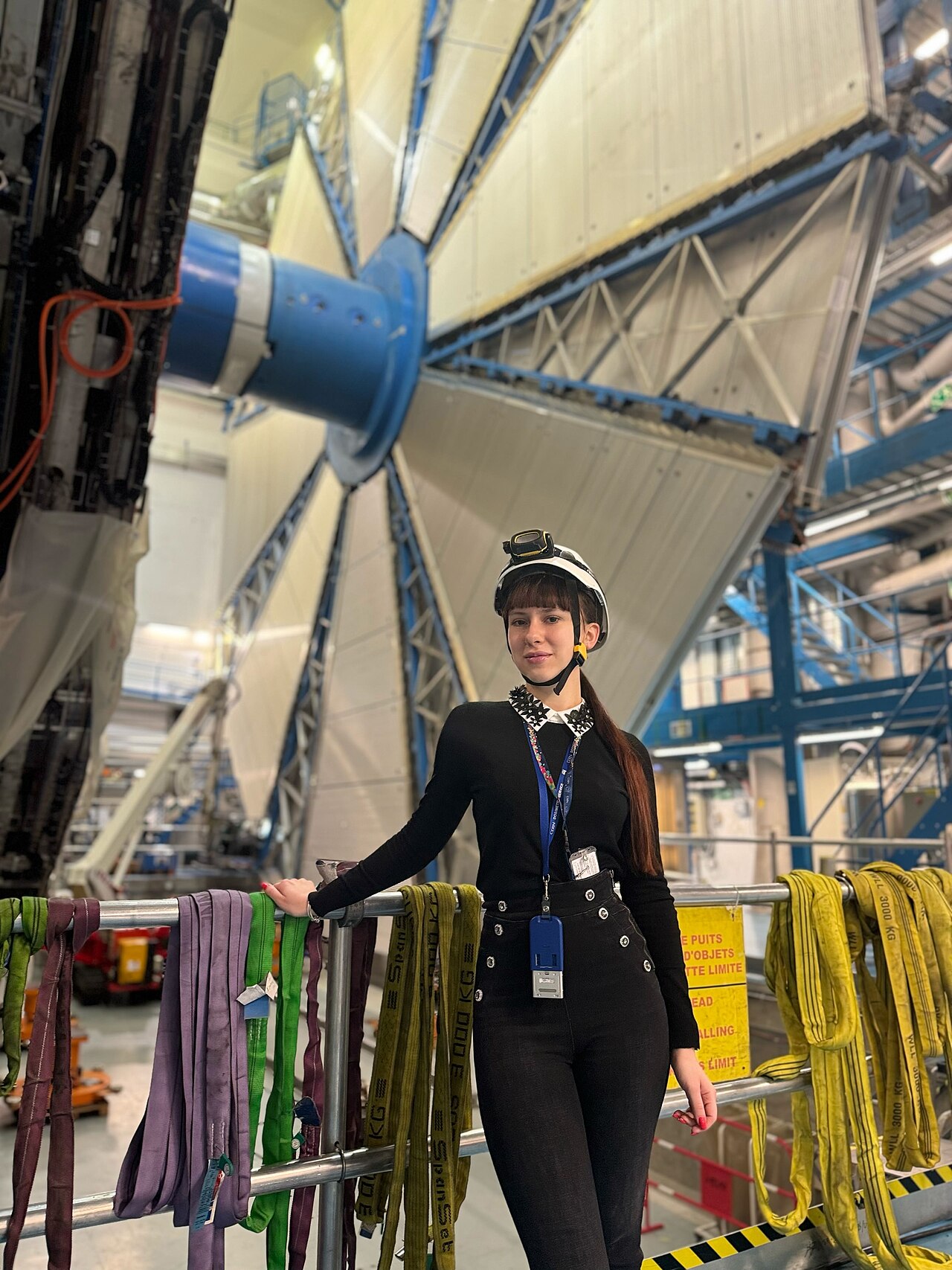
Today, LHC collision analysis relies on a chain of specialised algorithms that progressively transform detector signals into the particles used in physics analysis. Machine learning has long improved individual steps; a foundation model could learn across the whole reconstruction chain and serve many tasks within one model. CERN Chief Information Officer Enrica Porcari said high-energy physics offers “a unique environment in which artificial intelligence can be developed and tested with exceptional rigour”. CERN already stores around one exabyte — one million terabytes — of LHC experimental data, and the High-Luminosity LHC, expected to begin operation around 2030, will increase collision counts tenfold. That combination of scale and precision is exactly the soil a science foundation model needs.
Europe’s “Science Sovereignty” Play
The synchronicity is no accident. Just last week Mistral released Le Chonk, Europe’s first trillion-parameter open-weight model; with Timestral and the CERN partnership it now adds fundamental science to the board. Johannes Brandstetter, Vice-President of AI for Engineering at Mistral, said the company is proud to explore with CERN what large-scale AI models can bring to the growing complexity of particle physics. Against the US–China arms race in general-purpose models, Europe is carving a differentiated path: open weights, vertical domains, and deep integration with fundamental science — a moat that is hard to copy.
For enterprises, Timestral matters just as concretely. Time series is one of the most common enterprise data types — sensor telemetry, observability metrics, financial flows. Industrial plants forecast process sensors against production schedules and catch equipment drift before failure; finance teams forecast flows, volumes and volatility across thousands of accounts. A forecasting foundation model that needs no GPU, works zero-shot out of the box, and can still be fine-tuned sharply lowers the barrier to predictive analytics.
Conclusion
In a single day, Mistral proved two things: the model race is not about size — 209M parameters can dominate a domain — and AI’s next frontier is not only chatbots. When foundation models walk into collider laboratories, whoever masters “science-grade” AI first holds the initiative in the next round of scientific discovery. Europe’s move is worth watching closely.