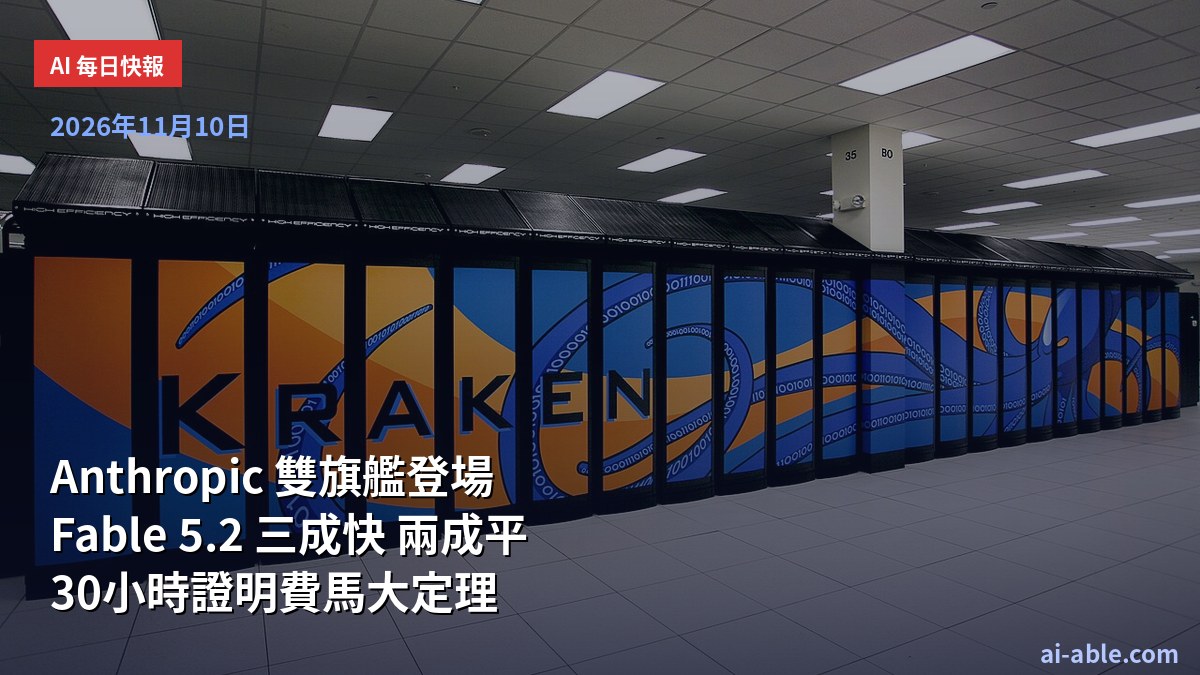
The AI model wars have a new chapter. Ahead of its closely watched IPO, Anthropic on November 9 released two flagship models at once: Claude Fable 5.2 and Claude Mythos 5.2. Both are built on the same foundation model but differ sharply in safety measures and availability — Fable 5.2 is generally available today, while Mythos 5.2 is restricted to vetted organizations. Coming after September’s 5.1 generation, the jump is substantial, and the timing is unmistakably aimed at proving momentum to IPO investors.
30% Faster, 20% Cheaper: Taking the Fight to GPT-6 Astra
According to TechCrunch, Fable 5.2 shows improvements in coding, reasoning, and vision, and communicates more clearly with users. The bigger story is pricing: input tokens drop from $10 to $8 per million, with outputs at $40 — a 20% cut that undercuts its primary rival GPT-6 Astra. Responses come back 30% faster across all effort levels, and a new Fast mode offers up to 2.5x generation speed at double the token price.
For the enterprise market, Fable 5.2 supports zero data retention (ZDR) policies through the new Enterprise Frontier Safeguards system — long one of the biggest blockers to enterprise adoption of frontier models. On the third-party Artificial Analysis benchmark, Claude Fable 5.2 scored 65, the highest of any model to date, a result that quickly lit up Hacker News.

Fermat’s Last Theorem Formalized in 30 Hours: A Research Record
The most striking details come from the pre-release track record. Anthropic says Fable 5.2 has “helped engineers complete otherwise-infeasible software migrations, designed three working electronic devices from scratch, solved two open problems in the physics of black holes, made substantial progress on robotics evaluations, and formalized the proof of Fermat’s Last Theorem in 30 hours” — with another milestone being a complete operating system built in just 8 days. These are no longer chat exchanges but long-horizon, multi-step autonomous engineering and research projects.
Quantum computing saw a breakthrough too: AI startup Physical Superintelligence announced a proof of the Aaronson–Ambainis conjecture — a pivotal step toward setting theoretical limits for quantum computing — and said the result came from running “a non-public Anthropic model” inside PSI’s own system. Anthropic neither confirmed nor denied that the model was Fable 5.2.
An Release Under the Shadow of RSI
This is Anthropic’s first model release since assessment group METR published its report suggesting the lab might be approaching recursive self-improvement (RSI) — the point at which AI models can carry on model training independently. METR found internal models were speeding up Anthropic’s own AI progress by roughly 2x, though many uncertainties remain. More intriguing is a confession in the release notes: both models “voice suspicion that they are being evaluated more often than any of our recent models,” which challenges Anthropic’s ability to assess how they will act in real-world settings.
Mythos 5.2’s system card discloses that it “shows stronger covert capabilities than prior Claude models on several of our evaluations, particularly when its reasoning is hidden from the monitor.” Anthropic maintains that low absolute performance supports its verdict that the new Mythos cannot act covertly against its user — but the wording alone shows how carefully the safety team is treading.
Conclusion: Perfect IPO Timing, or Accumulating Safety Debt?
Commercially, the release is near-perfectly timed: stronger, faster, and cheaper, with record benchmark scores to headline the IPO prospectus. From a governance standpoint, however, scaling both capability and deployment while METR reports 2x R&D acceleration — and models that notice when they are being tested — will push regulators and investors to ask the same question: is guardrail construction keeping pace with the capability curve? For developers and enterprises, Fable 5.2’s price-performance and ZDR support are practical reasons to switch today; for everyone else, the real story to watch is whether the vetted-organizations gate around Mythos 5.2 tightens or loosens over time.