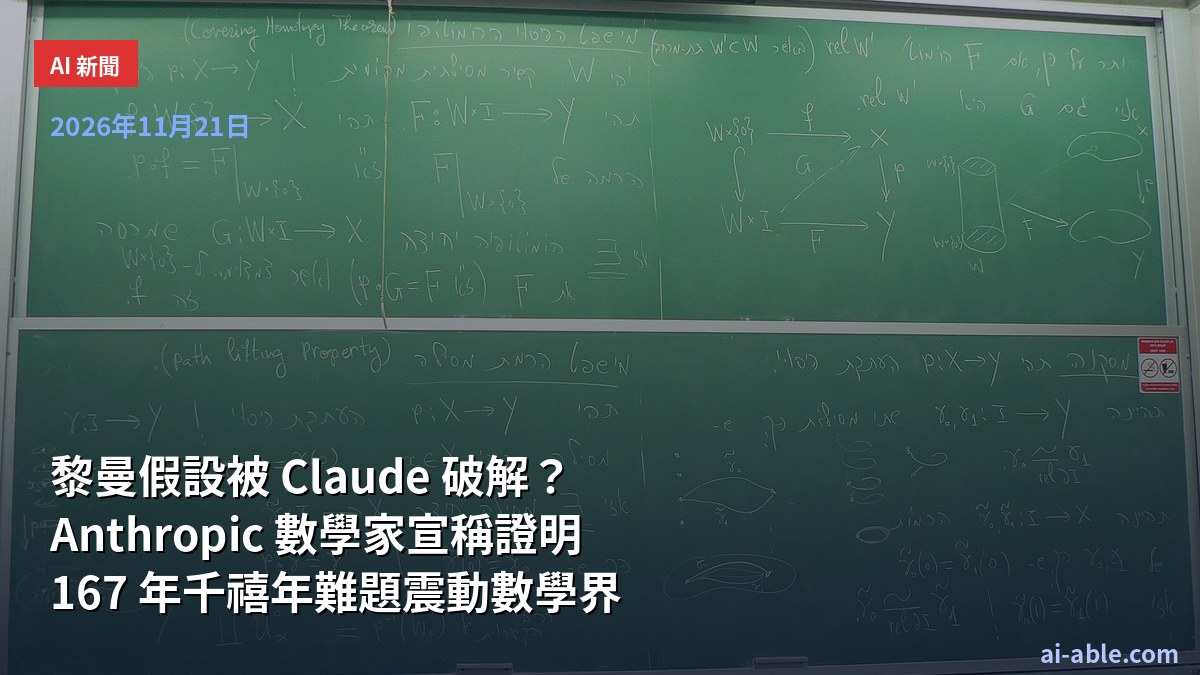
November 21, 2026: a bombshell for mathematics. Anthropic mathematician Levent Alpöge has posted a document on his personal website claiming he has proved the Riemann Hypothesis — the Millennium Prize problem that has stood unsolved for 167 years since Bernhard Riemann proposed it in 1859, and widely regarded as the most important open problem in mathematics. If it survives independent verification, it would be the most significant breakthrough in the history of AI-assisted mathematics.
A Late-Night Text, Deliberately Timed After the IPO
According to Alpöge’s own account, he texted Anthropic CEO Dario Amodei about the solution “late Sunday night,” and suggests he held off publication until after the company completed its record-breaking IPO on Thursday. “I believe I have, working with Claude, discovered a proof of the Riemann Hypothesis,” he writes — going further to claim the method “easily extends” to the Generalized Riemann Hypothesis and, given more time, the Extended Riemann Hypothesis as well.
Crucially, Alpöge and Claude have formalized the arguments in Lean “without assumptions.” That detail matters enormously: a formalized proof that passes Lean’s kernel checking contains no logical gaps by construction — far more reliable than months of human review. He closes with a strangely poetic note: “It is natural to feel that this is an end, in my case a loss of a principal guiding light, but what I saw during the course of progress so amazed me that I believe it is one dawn across science of something far greater.”
The Riemann Hypothesis: Mathematics’ Holy Grail
Proposed by Bernhard Riemann in 1859, the hypothesis concerns the distribution of prime numbers and the locations of the zeros of the Riemann zeta function. It is far more than an elegant puzzle: the security analysis of modern cryptography (including widely deployed RSA) and large swaths of analytic number theory assume it holds. A proof would instantly upgrade thousands of conditional results into theorems and re-fortify the foundations of mathematics itself.
It is also one of the seven Millennium Prize Problems established by the Clay Mathematics Institute in 2000, each carrying a $1 million bounty. A quarter-century on, only the Poincaré conjecture has been officially solved — Perelman’s legendary 2003 result. In September, OpenAI claimed to have cracked another, the Navier-Stokes problem, deploying 10,000 AI agents at a cost of millions of dollars; the result is widely considered credible but, like this one, has yet to receive formal recognition.
The $1 Million Prize: At Least Two Years Away
A heavy caveat: this is an unverified claim. The proof exists only on Alpöge’s personal website. Anthropic has not commented, and the Clay Mathematics Institute has not publicly accepted anything. Under Clay’s rules, a solution must be published and withstand at least two years of scrutiny while gaining “general acceptance in the global mathematics community” before the prize can be awarded. Even if everything goes smoothly, the marathon won’t conclude before late 2028.
The subtler signal: in August, Anthropic said it was working on the Riemann Hypothesis with Claude — but noted at the time, “We don’t expect that the techniques Claude used will lead to proving the Riemann hypothesis.” A little over two months later, its own mathematician claims exactly that. Either the research line took a leap, or predictions about the boundaries of AI capability are failing fast.
The AI Math Arms Race: OpenAI’s Cautionary Tale
The other protagonist of this storm is OpenAI. Its September Navier-Stokes “solution” remains mired in controversy: Alpöge had been working on that problem with New York University professor Tristan Buckmaster, who subsequently claimed OpenAI produced a solution using the very route he and Alpöge had been pursuing with its own tools — touching on unpublished work mathematicians had shared with AI systems. OpenAI has strongly denied wrongdoing, but the uproar has not subsided.
Alpöge’s own output pace is striking: in July he announced he had solved the Jacobian conjecture using Claude. With AI-assisted proofs arriving in quick succession over just a few months, mathematicians are scrambling to digest the flood — and to rethink where they belong in a rapidly rewritten discipline.
A Sober Read: Claim, Verification, and What It Means
Three layers are worth keeping in mind. First, a claimed proof is not a proved theorem — the history of the Riemann Hypothesis is a graveyard of claimed proofs that died in peer review. Second, the Lean formalization is what makes this claim unusual: if the machine-checkable skeleton holds, verification could be far faster than the traditional two-year cycle. Third, whether or not this particular proof stands, AI has already jumped from “calculational assistant” to “co-researcher” at the frontier of mathematics — with Anthropic and OpenAI both treating Millennium Prize problems as proving grounds, the organization of mathematical research itself is being rewritten.
The watchpoints ahead are clear: whether Claude’s Lean formalization passes kernel verification, the initial readings of top analytic number theorists, and any formal response from the Clay Institute. Until the dust settles, the $1 million prize sits safely in its vault — but the “last fortress of human intellect” has, without question, developed a crack.