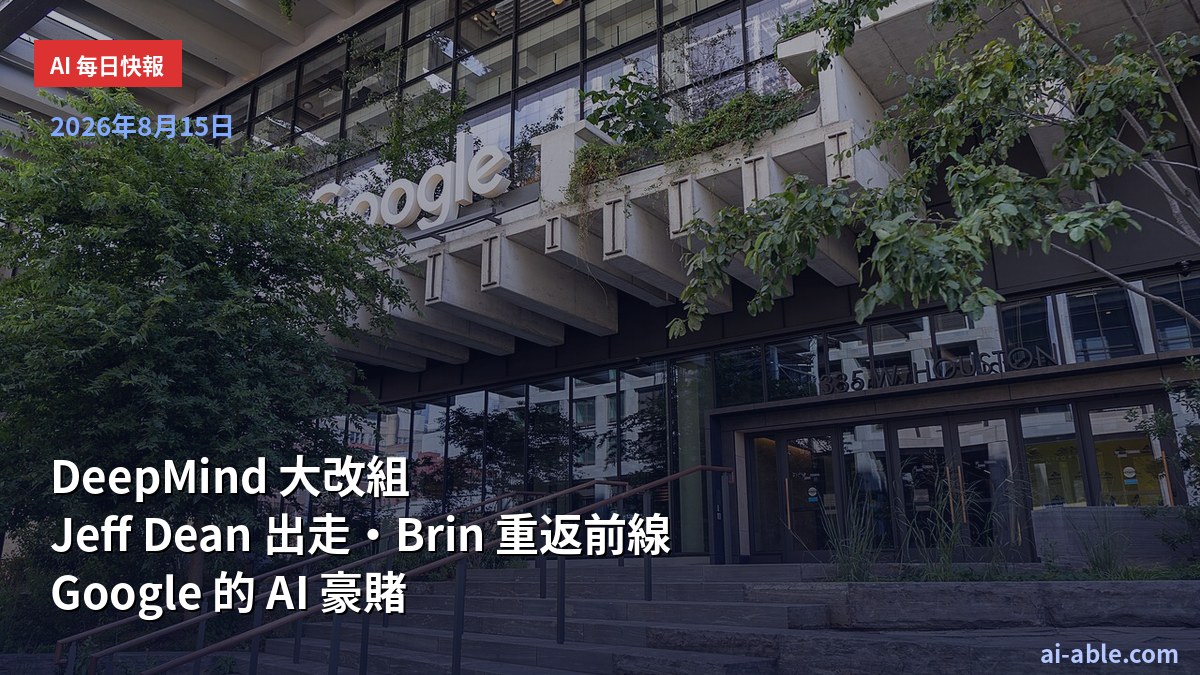
In early August 2026, Alphabet carried out the largest leadership overhaul in the history of its central AI lab, Google DeepMind: CEO Demis Hassabis stepped back from day-to-day management to become chairman, 27-year chief scientist Jeff Dean resigned to found a startup, and co-founder Sergey Brin returned to the front lines to personally steer Gemini model development. A week of executive turbulence, a Reuters exposé on the internal strategy shift, and the launch of the new Gemini 3.7 Flash together make this DeepMind shakeup a perfect lens for reading the state of the AI industry.
A Triple Shock in One Week: Reshuffle, Exits, and a 4% Stock Dip
On August 5, Alphabet made it official. Hassabis vacated the Google DeepMind CEO seat, becoming chairman of DeepMind while taking on an Alphabet chief scientist role; according to Reuters, operational control passed to former CTO Koray Kavukcuoglu. The same day, Jeff Dean — the legendary engineer behind MapReduce and Google Brain — confirmed his departure after 27 years, co-founding the AI-for-science startup Discovery Loop with Sanjay Ghemawat, Oriol Vinyals, and Quoc Le. GOOG shares slid roughly 4% within hours as markets priced in the brain-drain risk, while internal message boards flooded with farewell memes.
Discovery Loop: Not a Rupture, but a Different Kind of Symbiosis
Notably, Discovery Loop is not a hostile defection. The AI-for-science startup is backed by Google itself as both investor and cloud partner, with the mission of applying frontier AI to scientific discovery. Jeff Dean’s storied track record — from MapReduce and Bigtable to Google Brain — plus two core Gemini researchers makes Discovery Loop a presumptive frontrunner in the science-AI race the moment it opened its doors. For Google, this “invest-to-influence” structure reduces the risk of direct competition while keeping an indirect channel into the emerging ecosystem. As for viral speculation that Hassabis himself considered leaving alongside Dean, he addressed employees directly in a lengthy LinkedIn post, stressing that he will pursue the AGI vision from his new role.

Brin Returns: Full-Throttle Gemini and “Recursive Self-Improvement”
A Reuters exclusive on August 12 revealed that Sergey Brin has spent recent months personally urging DeepMind researchers to go “all in” on Gemini, explicitly naming recursive self-improvement as a research priority. The same report disclosed that Alphabet delayed its flagship Gemini 3.5 Pro after internal benchmarks showed it lagging rivals in coding. Squeezed between OpenAI and Anthropic, Google has chosen to put its most technical founder back at the center of decision-making to accelerate productization — a rare move in the company’s history.
Gemini 3.7 Flash Arrives: The First Step of Differentiated Competition
Less than ten days after the shakeup, Google launched Gemini 3.7 Flash on August 13, a model purpose-built for software coding and automated agent workflows. While the flagship Pro model remains in the workshop, this “workhorse” model targets the scenarios enterprises pay for most readily — a signal that Google’s strategic center of gravity is shifting from leaderboard rankings toward monetizable developer markets. With Gemini now surpassing 950 million users and Google Cloud growth accelerating, the commercial AI story at Google remains intact.
Analysis: Brain Drain, or Ecosystem Diffusion?
On the surface, losing a CEO, a chief scientist, and two Gemini co-leads in a single day reads as a catastrophe. Viewed differently, the continued dispersion of DeepMind-trained talent is itself proof of the lab’s ability to breed leaders. The deeper script behind the shakeup is the long-running tension between London and Mountain View, and between research idealism and product urgency. Whether Hassabis can preserve the scientific culture as chairman, whether Kavukcuoglu can withstand productization pressure, and whether Brin’s return proves to be medicine or interference — these will jointly determine Google’s position in the next round of the model race.
Conclusion and Actionable Takeaways
The DeepMind reorganization is not an ending but a watershed: Google’s AI strategy is fully pivoting from “research institute mode” to “product warfare mode.” For developers and enterprises, Gemini 3.7 Flash — optimized for coding and agent workflows — is worth immediate evaluation. For investors, flagship model performance and senior talent retention over the next two quarters will be the key metrics of this gamble. The AI talent war shows no sign of a ceasefire, and Google is demonstrating with action that it intends to stay at the table — with its co-founder personally holding the chips.