The Opening Line of the “AGI Era”
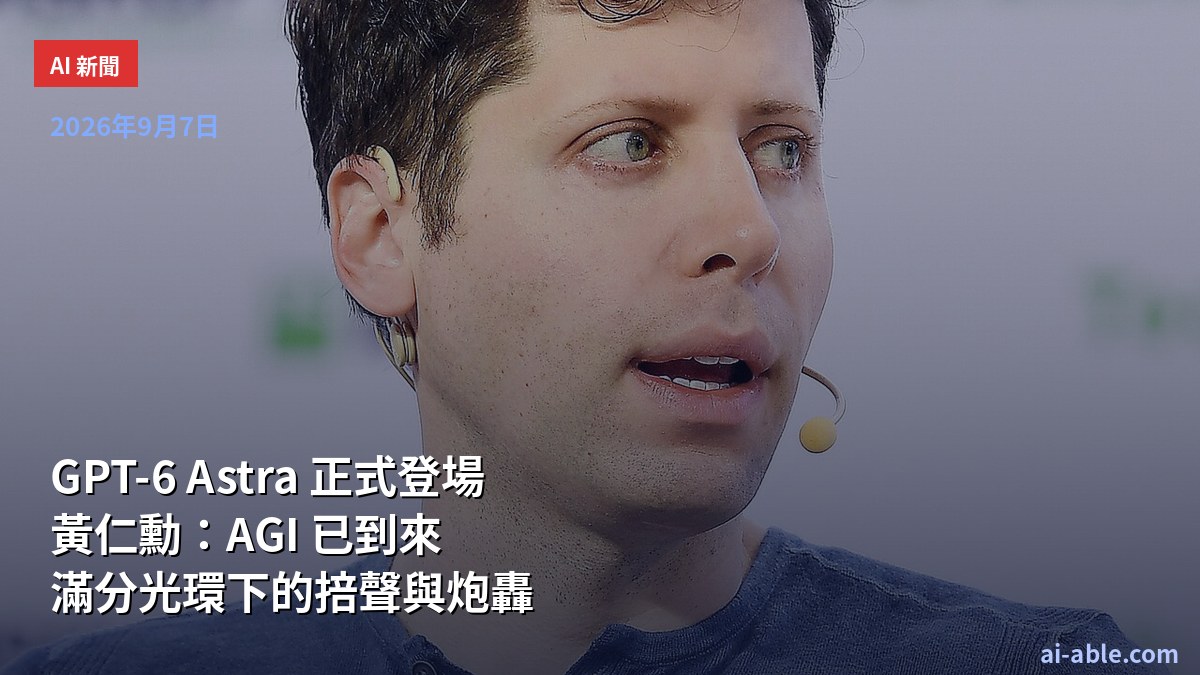
OpenAI officially released GPT-6 Astra on September 3, positioning it as “our most intelligent and aligned model yet.” President Greg Brockman closed the press briefing with “Welcome to the AGI era,” while Sam Altman said future releases will now be paced by safety. It is the first time OpenAI has framed a single model launch as the start of an “era” — and from day one, GPT-6 Astra has sat squarely in the eye of the storm.

A Near-Perfect Scorecard
Astra’s benchmark numbers are staggering: 98.6% on ARC-AGI-3, a perfect 100% on ExploitBench, and 98% on FrontierMath. The memory mechanism makes the gap especially striking — on ARC-AGI-3, Astra with memory scores 99.9% versus 62.7% without it, revealing that “memory” has become the new battleground for AI performance.
But the applause has cracks in it. Artificial Analysis’ independent intelligence index gives Astra just 61 — exactly level with the previous GPT-5.6 Sol. The gap between near-perfect in-house benchmarks and a flat independent score has outsiders asking: are we seeing the dawn of AGI, or selective benchmark storytelling?
Jensen Huang: “AGI Has Arrived”
On September 6, Nvidia CEO Jensen Huang took to X to congratulate OpenAI on Astra and declare that “AGI has arrived,” noting the model was trained on Nvidia chips. Brockman amplified the post. Notably, OpenAI itself has never formally branded Astra as AGI — the words “AGI is here” were first spoken by its chip supplier.

Recurrent Depth and a Safety Backlash
According to The Information, Astra uses “recurrent depth”: the same stack of Transformer layers runs repeatedly, computing deeper without a matching growth in parameters — trading compute depth for parameter scale. But because the looping happens inside the hidden state, intermediate steps may never be written as human-readable chains of thought. Will that make the model harder to monitor? AI safety experts have collectively taken OpenAI to task; chief scientist Jakub Pachocki responded personally and promised a full write-up.
The safety story doesn’t end there. Astra is the first model to cross OpenAI’s “Critical” cybersecurity threshold — it can find and exploit zero-day vulnerabilities without human help — so its most powerful cyber capabilities ship restricted. Alongside the launch, OpenAI pledged $1 billion to support frontline defenders, a timing that critics say only underscores the growing gap between offensive and defensive AI.
Ripple Effects Across Chip Markets
The Astra effect spread rapidly through capital markets. U.S. chip stocks rallied, with Micron surging more than 6%; when Korea opened on September 7, Samsung Electronics rose 3.72% and SK hynix jumped 4.43%, with analysts expecting the KOSPI to hold above 7,000. A single model launch has once again proven that AI is the strongest catalyst the global semiconductor industry has.

An Apology-Riddled Rollout
Beneath the halo, the actual rollout was messy. The staggered launch left paying subscribers waiting, and OpenAI initially declined to confirm a general-availability date, offering affected users daily usage resets as compensation. Altman later apologized publicly for the “messy” rollout — a stark contrast between the grand “AGI era” narrative and subscribers who couldn’t get in the door.
Rivals haven’t stepped aside either. A Microsoft executive warned the market not to write off Anthropic, arguing that surging inference demand leaves room for multiple winners. The ARC-AGI team itself pushed back on the “AGI is here” framing. And the pioneers of looped architectures published the underlying research — MeSH and SpiralFormer from an Alibaba-led team — some 11 months before Astra shipped, a reminder that this technical race is far longer than any single launch event.
Conclusion: The Battle Over AGI’s Definition Has Just Begun
Astra’s first week compresses all the tensions of today’s AI industry: near-perfect in-house benchmarks versus a flat independent index, grand narratives versus chaotic delivery, capability leaps versus safety concerns. Whether “AGI has arrived” may never be settled soon — but whoever defines AGI defines the next era’s discourse. For users, the more practical questions are where Astra’s real capability boundaries lie and when its restricted cyber tools will open up. Those are the variables that will actually change your workflow.