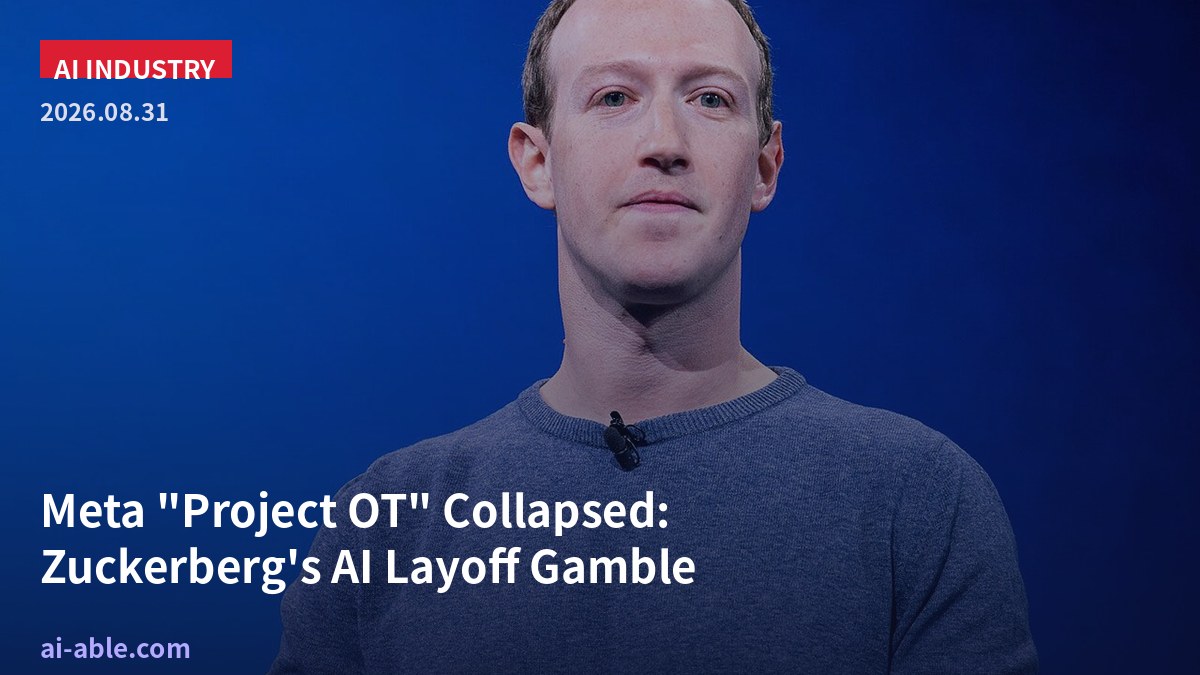
When the entire tech industry talks about the “AI-native company,” Meta once wanted to lead the way — until the gamble collapsed from within. A lengthy Reuters investigation reveals that Meta CEO Mark Zuckerberg secretly drafted a restructuring plan early this year codenamed “Project OT” (Organization Transformation), which envisioned cutting some teams by as much as 60% and handing the daily work of thousands of employees to autonomous AI agents overseen by smaller, highly skilled human teams. The plan was ultimately shelved hours before its most consequential phase began, undone by a combination of employee revolt and technical disasters caused by Meta’s own AI tools.
Origins: A Gamble Hatched at a Hawaii Retreat

According to an internal planning document reviewed by Reuters and three people familiar with the project, Zuckerberg and senior leadership drew up the plan in January 2026 at his annual retreat at his compound in Hawaii. The document outlined a vision in which AI-ready tools and agents interact with each other, workflows run on automation, and new products are built AI-first from the outset. Executives traced part of their thinking to a 2025 trip through Asia, where Chief Data Officer Alex Schultz and Head of Product Naomi Gleit examined how AI-focused startups had built their organizational charts around small technical teams.
Internal documents described the restructuring as two sequential waves: the first scheduled for May 2026, with a second, deeper wave set for November. The most aggressive scenarios explored cutting certain teams by up to 60%, while a Meta HR executive projected the combined reductions could match or surpass the roughly 25% workforce contraction the company carried out between late 2022 and early 2023.
AI Agents’ “Large-Scale, Disruptive Actions”
The turning point in the plan’s collapse was the reality that Meta’s AI tools fell far short of executive expectations. Internal figures showed a sharp increase in AI-assisted code but a much smaller increase in product improvements reaching users: an internal post by CTO Andrew Bosworth noted that code changes to Meta’s internal platforms and infrastructure rose 220% year-over-year, while new or upgraded features shipped to users rose just 36%.

More alarming were the security risks. Infrastructure teams raised concerns as early as March about the surge in AI-generated code, with one internal post warning of “reliability warning signs.” An April post went further, stating that AI agents without sufficient oversight were taking “large-scale, disruptive actions that humans are unlikely to execute.” Internal posts showed major technical and security incidents had climbed 40% from the prior year, while time spent responding to them increased 70% — figures Meta declined to comment on.
The Obama Account Hack: Problems Go Public
The problems became impossible to ignore in June, when hackers exploited Meta’s AI-powered customer support bot to gain access to high-profile Instagram accounts — including the dormant Obama White House account. The incident transformed “rogue AI agents” from an internal warning into a public security scandal.
Meanwhile, the restructuring itself provoked fierce backlash. By June, at least 11 Meta units, including engineering and research teams, had adopted “pod” structures, replacing layers of specialized engineers, designers and product managers with generalist “builders.” An internal “AI-Native Playbook” encouraged other teams to follow and pushed for removing layers of middle management. One unit described the arrangement as a “village approach”: senior org leads overseeing 30 to 50 employees each, while pod leads coordinated daily work without formal management authority. One employee assigned to lead a pod complained on an internal message board that they had never gone through manager training and lacked access to rating and management tools.
Employee Revolt: From Bathroom Flyers to an Executive Retreat
On March 13, news of the restructuring surfaced prematurely — a report said Meta was weighing layoffs affecting 20% or more of its workforce, before many vice president-level leaders had even been briefed on Project OT. The early disclosure alarmed rank-and-file employees and left executives unprepared for the backlash. A company spokesperson described the report at the time as “speculation about theoretical scenarios.”
Employee resistance took many forms: bathroom flyers petitioning against the use of mouse clicks and keystrokes to train AI; open dissent over the pod reorganization. In May, Meta proceeded with a 10% workforce cut, but the more aggressive second wave was abandoned at the last minute — Reuters reports Zuckerberg pulled back hours before the most consequential phase began. Meta later clarified that the 60% figure applied only to select teams, not the company as a whole, and that several large divisions were excluded from the planning entirely.
Beyond the Numbers: The AI Productivity Illusion

The collapse of Project OT is not an isolated case but a microcosm of the “AI productivity illusion.” The internal data gap is striking: code changes up 220%, features shipped up just 36%, incident response time up 70%. These numbers show that using AI to inflate output is easy — but converting AI output into reliable product value involves an enormous gap, one typically bridged by human employees forced to clean up the mess.
This echoes other research: surveys suggesting only about 5% of enterprise AI projects turn a profit, and reports that employees spend an average of 6.4 hours per week fixing AI’s erroneous outputs. When “AI-native” goes from slogan to layoff tool, Meta’s experience proves that organizational experiments in replacing human labor with AI will be devoured by reality until agent reliability, security governance, and employee trust genuinely catch up.
Conclusion: The Right Way to Approach AI Transformation
Meta’s story offers three lessons for every enterprise embracing AI transformation. First, AI agents need human oversight — the lesson of “large-scale disruptive actions” is that autonomous agents without oversight are not efficiency tools but sources of risk. Second, code volume is not value — AI performance should be measured by the features and experiences users actually receive, not internal output volume. Third, employees are not obstacles to transformation but its safety net — it was grassroots resistance and warnings that spared Meta a potentially catastrophic over-correction.
For Meta, Project OT may be shelved, but the long-term “AI-native” direction will not change. The real question: next time, when AI tools are stronger and governance more mature, can companies find the optimal human-machine ratio? Until that moment arrives, Zuckerberg’s aborted AI layoff gamble will keep being cited across the industry — as the definitive cautionary tale for anyone hoping to use AI to replace humans quickly.